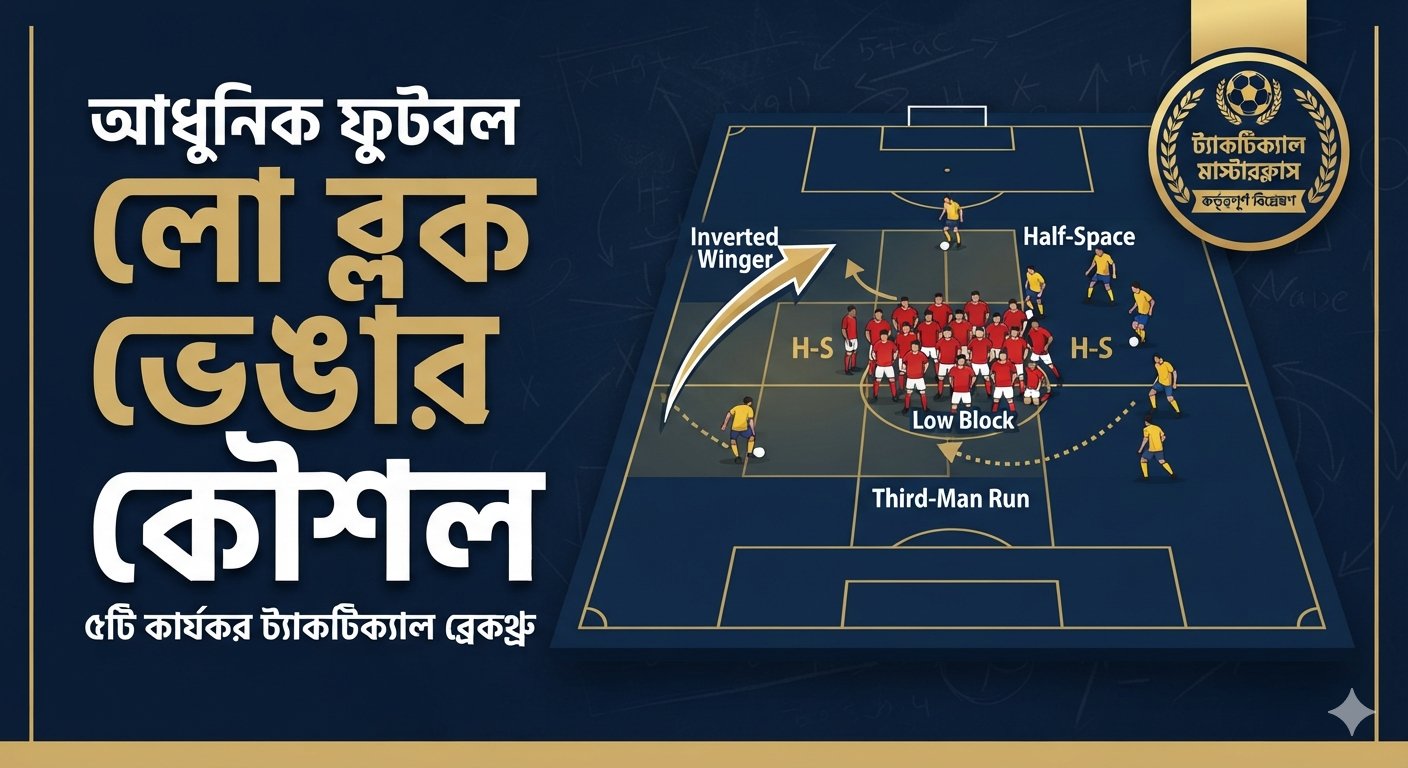
Strategies to Break Down Low-Block Defenses in Modern Football: 5 Core Methods and In-Depth Tactical Analysis
In the tactical landscape of modern football, the art of balancing attack and defense has been pushed to its limits. For any elite team that relies on possession and high pressing, the most vexing challenge is how to break down an opponent's low-block defense. When a defending team packs nine or ten players into the defensive third—or even right at the edge of the penalty area—for extended periods, traditional lateral passing and sterile possession become meaningless. This article adopts the perspective of an in-depth tactical analysis to comprehensively dissect the five core strategies for overcoming low-block defenses in modern football.
I. Localized Overloading and Space Compression in the Half-Space
The ultimate goal of a low-block defense is to lock down the central area of the pitch. In such a spatially compressed environment, blindly forcing an attack through the middle is akin to running into a brick wall, while relying solely on crosses from the flanks makes the ball easy prey for towering opposition center-backs. Consequently, the "half-space"—the zone bridging the flank and the center—emerges as the most lethal strategic point for a breakthrough.
Vertical manipulation by inverted wingers: When an inverted winger cuts inside from the flank into the half-space, they force the opposing full-back or defensive midfielder to step out of the defensive line to cover, instantly disrupting the horizontal structural integrity of the low-block defense.
Localized overloading (Overload to Isolate): By concentrating three or four players (e.g., left-back, left-midfielder, and left-winger) in the left half-space for rapid one-touch passing, the team draws the opponent's defensive focus entirely to one side; a subsequent precise long-range switch of play then creates prime 1v1 space for the right-winger on the far side to drive at the defense. II. The Dynamic Geometry of "Third-Man Runs"
Against a static low block, the defense is highly elastic. Search trends in tactical databases indicate that the "third-man run" is one of the most frequently discussed concepts among modern coaches when devising ways to break down compact defenses. This is because defenders in a low block tend to focus primarily on the movement of the ball and the player immediately receiving it, making the "blind-side" run of a third player unpredictable.
A classic example of this pattern involves Player A (a midfielder in possession) passing to Player B (a target-man striker playing with their back to goal) positioned in a gap within the defensive line; at this moment, the defenders' attention is entirely fixed on Player B. Simultaneously, Player C—initially positioned outside the defensive structure (such as a late-arriving "No. 8" midfielder or an overlapping full-back cutting inside)—bursts into the space behind the defense at high speed. Player B then executes a quick one-touch lay-off or through-ball, allowing Player C to break through on goal. This dynamic interplay of movement and passing acts as a "scalpel," effectively slicing open a static low-block defense.
III. The Synergy Between Inverted Full-Backs and the "False Nine"
As renowned coaches like Pep Guardiola and Mikel Arteta have popularized the "inverted full-back" tactic, this role has taken on a new mission in strategies designed to dismantle low-block defenses.
Midfield Numerical Superiority: When a full-back inverts into a defensive midfield position during an attack, the attacking team automatically gains a local numerical advantage near the edge of the penalty area (Zone 14). This positioning effectively cuts off the primary passing lanes the defending team would use to launch a counter-attack. Unleashing the "False 9": Inverted full-backs take on playmaking duties, allowing the center-forward (acting as a False 9) to drop into midfield to receive the ball without hesitation. This drags opposing center-backs out of their defensive posts in the penalty area, creating valuable pockets of space for wingers to exploit with forward runs.
IV. Long-range Bombardment of Zone 14 and High-intensity Pressing for Second Balls
In the tactical landscape of football, Zone 14—the prime area directly in front of the penalty box—is known as the "Golden Zone" or "Finishing Zone." Teams employing a low block often retreat too deeply into their own penalty area, inadvertently creating a momentary defensive void in Zone 14.
Modern strategies for breaking down low blocks emphasize the need for players capable of powerful long-range shooting. A few seemingly innocuous long-range attempts can force the opponent's defensive midfielders or center-backs to step up and close down the shooter. Once the defensive line is forced forward, the compactness of the "parked bus" formation disintegrates, opening up gaps for penetrative passes. Furthermore, long-range shots that cause the goalkeeper to spill the ball or lead to hurried clearances can trigger high-intensity pressing to win the "second ball" in Zone 14, delivering a lethal blow during the chaos of the opponent's defensive transition.
V. Set-piece Nuance and Creating Space in Tight Situations
When open play fails to breach a low block during regulation time, set-pieces serve as the ultimate equalizer. During dead-ball situations, the defending team cannot rely on collective movement to cover space, effectively neutralizing the numerical advantage inherent in a low block.
Modern clubs increasingly employ specialized set-piece coaches. Through decoy runs at the near post, "pick-and-roll" style blocks in the center (borrowed from basketball tactics), and "anti-offside" lurking at the far post, teams can artificially manufacture split-second openings within the crowded penalty area. For teams that rely on a low-block defensive strategy, a single lapse in defending a set-piece is often enough to dismantle a defensive line that has held firm for 80 minutes.
Conclusion: The Ultimate Duel Between Tactical Counter-Strategies and Execution
In summary, strategies to break down a modern low-block defense do not rely on the individual brilliance of a single superstar; rather, they depend on a multi-dimensional attacking system built upon dynamic overloads in the half-spaces, precise timing of "third-man" runs, pressure in the central "Zone 14," and meticulously designed set-piece routines. As football continues to evolve, the team that can best master the art of squeezing space will ultimately emerge victorious in this supreme battle between offense and defense.
Strategies for Breaking Down Low-Block Defenses in Modern Football
• Half-space Strategy: Employing rapid, short passing in the ball-side half-space to draw the defense laterally, followed by a sweeping diagonal switch to the weak side, creating 1v1 isolation opportunities for explosive wingers. • Third-man Runs: Leveraging a ball-carrier and a second player (such as a target man playing with his back to goal) to absorb defensive attention, while a third player bursts from the opponent's blind side—cutting past the defensive midfielder—to tear open the defensive line. • Localized Overload: Artificially creating a numerical advantage (e.g., 4v3 or 5v4) in a specific zone to compress the opponent's defense, subsequently exploiting space on the far side through the logic of "reverse isolation." • Zone 14 Threat: Utilizing long-range shooting threats from the area just outside the penalty arc to force a deep-sitting, compact defense to step up, thereby creating gaps and pockets of space for ground-based penetration. • High-press Recovery: Winning the ball back immediately—within the "golden five seconds" following an opponent's clearance—to deliver a lethal follow-up blow while the opposition is at its most vulnerable during the transition from defense to attack.